
“Rahiman, what is beyond comprehension cannot truly be spoken or narrated.
Those who truly know, do not speak; and those who speak, perhaps do not truly know.”
Prakriti and Purusha—or, if we put it more broadly, Existence itself.
Perhaps trying to explain or completely understand Existence is nothing more than a childish attempt.
After all, how can that which contains us be completely understood by us?
The Vedas and the Upanishads too, when they approach that ultimate Truth, sometimes seem to stop where words themselves begin to fail.
Neti, neti.
Not this.
Not that.
“Those who truly know, do not speak; those who speak, perhaps do not truly know.”
And now, if I am taking the audacity to speak about something as vast as this, then perhaps the simplest conclusion is—
I do not know.
Those who speak, perhaps do not truly know.
And yet…
The question remains.
Perhaps the very arising of the question is where the journey begins.
Namaste!
Welcome, all you curious seekers, to SvayamPradeep.
What is this Existence after all?
A few days ago, we celebrated Navratri.
Festivals have their own beauty.
They bring enthusiasm into life, add colour to our days and, in a way, recharge life with a little more life.
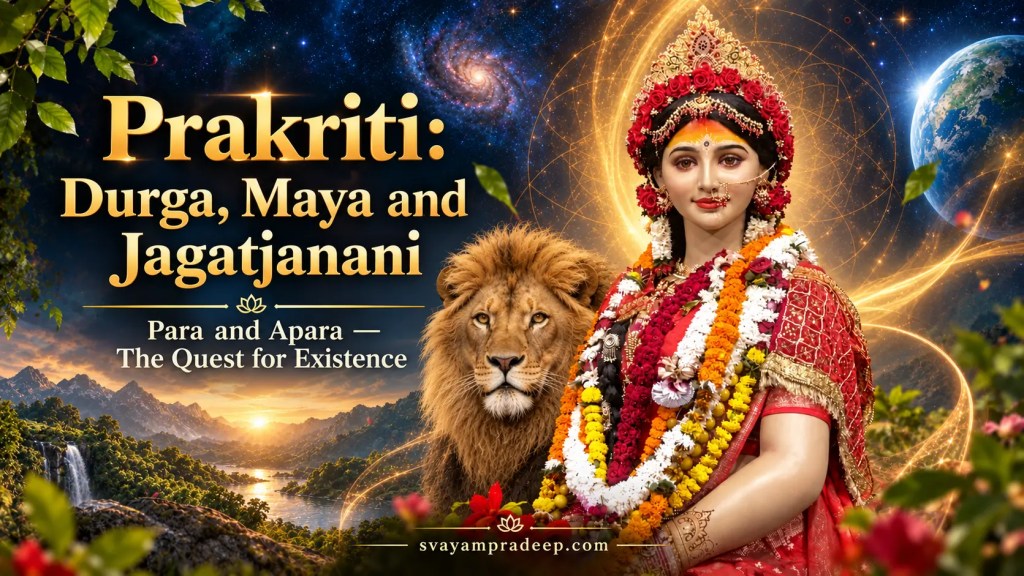
Navratri is one such beautiful festival, traditionally associated with and dedicated to Maa Durga, the Divine Mother and the embodiment of Shakti.
But what does this festival have to do with today’s subject—
“Prakriti and Purusha”?
Let us begin.
Whenever we speak of Existence, we do not experience only our own existence.
Along with ourselves, we experience an entire world.
And this is where curiosity begins.
I exist in this world.
But how did this world come into existence?
I seem to have been born within this world, shaped by this world.
But how did this world itself come into being?
Since when does it exist?
Until when will it exist?
And perhaps the biggest question—
Why does any of this exist at all?
The mind becomes tired.
The intellect becomes exhausted.
We study scriptures and philosophies. Sometimes they give us a little support. Some answers appear. Some directions become visible.
But after walking a certain distance, even our studies seem to bring us to a boundary where words begin to disappear and the question returns once again.
My existence is experienced by me now.
But what was I before this?
What did I look like?
Where was I?
With whom was I?
I remember nothing.
And what about the future?
What will happen then?
I do not know that either.
So is Existence only what I am experiencing right now?
Or was I, in some form, present before this?
And will I continue in some form after this?
Questions rise within like an ocean.
And then…
the mind becomes tired.
What if we simplify Existence?
If we try to divide the whole of Existence in the simplest possible way, we might say—
Existence = Living + Non-living
But immediately another question appears—
Who created both?
And then the mind tries another simple model.
Existence = Conscious + Matter + That Ultimate Reality upon which both depend.
Indian philosophical traditions have approached this question in different ways.
We encounter words such as Jiva, Prakriti, Purusha, Brahman, Maya, and many others.
In very simple terms, we can say that three things seem to stand before us—
- The inert or material — Prakriti
That which appears, changes and takes countless forms. - The conscious — Jiva
That which experiences, knows and asks questions about its own existence. - The Ultimate Reality — Brahman
That which different philosophical traditions have attempted to understand as the ultimate ground of Existence.
And here, the question of Prakriti and Purusha begins to emerge.
Then what does Maa Durga have to do with all this?
Now perhaps it becomes easier to understand why I mentioned Maa Durga in the beginning.
In Indian traditions, Prakriti is not merely treated as lifeless matter.
Especially within Shakta traditions, Prakriti is understood through the idea of Shakti—the Divine Power through which the manifest universe appears.
That is why Maa Durga need not be understood merely as an image meant for worship.
She can also be understood as a symbol of Shakti.
The power of creation.
The power of transformation.
The power through which this visible world manifests in its countless forms.
But then another fascinating question arises—
Is Prakriti separate from its Creator?
Duality says—there are two
Indian philosophy has approached this question through different paths.
One perspective says—
There are two.
There is the creation, and there is the Creator.
The two are distinct.
This takes us broadly towards the idea of Dvaita, or duality.
But another perspective says—
They appear to be two, but fundamentally they are not two.
And this takes us towards Advaita, non-duality.
Perhaps the distance we see between the creation and the Creator is actually a limitation of our own perception.
So what is the Truth?
Again, the problem returns.
How can we say?
Based on what we can presently experience, one thing is certain—
the creation is visible.
But the Creator is not directly visible.
Prakriti is visible.
Trees are visible.
Rivers are visible.
Mountains are visible.
The sky is visible.
Life is visible.
We are visible.
But that ultimate Reality we keep asking about—
“From where and how did all this come?”
—that does not simply appear before our eyes.
And perhaps this is why human beings, across ages, have used words such as God, Brahman, Purusha, Shakti and Prakriti in their attempt to understand the incomprehensible.
What exactly is Prakriti?
Let us ask a very simple question—
What do we call Prakriti?
Usually, we call the things around us nature.
Trees are natural.
Rivers are natural.
Mountains are natural.
Birds are natural.
Animals are natural.
But human beings?
Here we become a little strange.
When we see a nest made by a bird, we say—
“What an incredible creation of nature!”
But when we see a house made by a human being, we say—
“A human being built it.”
Humans built roads.
Humans built bridges.
Humans built ships.
Humans built buses.
Humans built trains.
Humans built spacecraft.
Humans built satellites.
Humans built computers.
And we call all of these human-made.
But stop for a moment.
Where did the human being who created all this come from?
Is the human being standing outside Nature as something separate?
Or is the human being itself a part of Nature?
If the human being is a part of Nature, then the things created by human beings are, ultimately, also expressions of Nature.
A tree gives us wood.
Wood becomes a table.
A human being makes the table.
But where did the human being come from?
Where did the elements that make up the human body come from?
Where did the human capacity to think come from?
Where did imagination come from?
Language?
Science?
Technology?
So can we really call something created by a human being completely separate from Nature?
Perhaps not.
Is the human being natural or human-made?
And now the question becomes even more interesting.
Is a human being natural?
Yes.
Because the human being did not arrive from outside Nature.
The human body is made from the very elements of Nature.
We are born within Nature.
We grow within Nature.
We change according to the laws of Nature.
And eventually, our bodies return to Nature.
But there is another equally fascinating fact—
Human beings can also transform Nature.
That is what makes this question so interesting.
A river flows along its course.
Human beings build a bridge across it.
A stone lies on the ground.
Human beings turn it into a building.
Metal exists within the earth.
Human beings turn it into machines.
Electricity exists as a phenomenon of Nature.
Human beings study it and create electrical systems.
Birds fly.
Human beings observe them and eventually build aircraft.
So are human beings separate from Nature?
Or are human beings a form of Nature that has developed the ability to observe Nature and transform it?
Perhaps this question brings us very close to Prakriti and Purusha.
And here begins the question of Purusha
Until now, we have been trying to understand Prakriti.
But now comes the deeper question—
Who is observing Prakriti?
A tree can be observed.
The body can be observed.
Thoughts can, to some extent, be observed.
Emotions can be observed.
Even the restlessness of the mind can be noticed.
But—
who is the one that is observing all this?
And who is observing that observer?
This is where the mystery of Purusha begins.
In Sankhya philosophy, Prakriti and Purusha are understood as two fundamental principles.
Prakriti is associated with change and manifestation, while Purusha is understood as consciousness—the witnessing principle, untouched by the changes of Prakriti.
But even here, we must be careful.
This is not a subject that can be finished in one simple definition.
Because the moment we say—
“Purusha is this.”
another question appears—
“Have we actually known it, or have we merely given it a name?”
And once again, Rahim’s words return—
“Those who truly know, do not speak; those who speak, perhaps do not truly know.”
Perhaps the problem is not the answer, but the one asking the question
Perhaps we cannot understand Existence because we are trying to understand it as though we are standing outside it.
But where are we outside Existence?
We are not.
The universe we are trying to understand contains our own body.
The Nature we are trying to know is also expressed through our own body.
And the very consciousness with which we are asking questions is the consciousness through which the question is being asked.
And perhaps that is the most fascinating thing of all.
Existence is trying to know itself through itself.
A human being looks towards the sky and asks—
“What is all this?”
But the one asking the question is also a part of that very “all this”.
So, are Prakriti and Purusha separate?
Perhaps one philosophy has an answer.
Perhaps another philosophy has another answer.
Perhaps both are meaningful within their own frameworks.
And perhaps our greatest mistake is our desire to capture the Ultimate Truth inside a definition.
We look at Prakriti and say—
“This is.”
We experience consciousness and say—
“I am.”
And while searching for the Ultimate Reality, we ask—
“Why is any of this?”
But eventually…
silence remains.
Neti. Neti.
Not this.
Not that.
And perhaps, standing at the edge of that silence, Rahim smiles and says—
“What is beyond comprehension cannot truly be spoken.”
Because perhaps the one who has truly known…
has nothing left to say.
And the one who has much to say…
is perhaps still travelling towards knowing.
So whatever I have said today—
do not take it as an answer.
Take it simply as a question.
An invitation to walk together.
Because perhaps the purpose of SvayamPradeep is not to place Truth in your hands as though it were an object that can be possessed.
Perhaps its purpose is simply to awaken a question within you—
“Who am I?”
And perhaps the next question is even deeper—
“Who, really, is this ‘I’ that I keep calling myself?”
Your fellow traveller : SvayamPradeep

